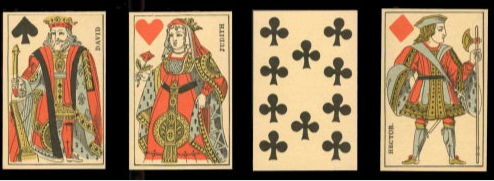
Playing cards were probably invented in China during the Tang Dynasty (618–907 CE) though they were rather different to the ones that we are familiar with today. There is a reference to something called the ‘leaf game’ being played by Princess Tongchang in 868 CE but it is unclear exactly what these leaves were. We know that this game often involved drinking – it was reported that the Emperor Muzong went on a 25-day drinking spree in the year 969 and on New Year’s Eve (26th February) “he played the game of leaves with his ministers”. This game would have been yezi ge (Rules of Leaves) but as long ago as 1067 CE it was recorded that there was no one alive who remembered how to play the game.
HIstory
The History Of The Roses (Part 2)
Evolution of the Rose
Nowadays, the genus Rosa encompasses around 150 species of erect, climbing, or trailing perennial shrubs with thousands of varieties. These stem from a very small number of original roses from Asia that were crossbred over the centuries with native European and American wild species.
Roses are classified into three types:
- species – the familiar ‘wild rose’
- Old World roses – introduced before 1867)
- modern roses
The History Of the Rose (Part 1)
The rose that grows in many different forms in gardens all over the world today is an evolution of rose-like plants that lived in the northern hemisphere between 33 million and 23 million years ago. Traces of them have been found in the fossil record of the Oligocene epoch in Europe, Asia, and western North America.
History of Knitting
Knitting is technique to turn thread or yarn into a piece of cloth. Knitted fabric consists of horizontal parallel courses of yarn which is different from woven cloth. The courses of threads or yarn are joined to each other by interlocking loops in which a short loop of one course of yarn or thread is wrapped over the bight of another course.
Continue reading →Sunflower History
The history of the sunflower (Helianthus annuus) is a fascinating journey from a wild North American native to one of the world’s most important oilseed crops. Its story spans thousands of years, multiple continents, and diverse cultural uses.
A View Of The History Of Playing Cards
The history of playing cards spans over a millennium, evolving from simple paper amusements in ancient Asia to the standardized decks that define modern games worldwide. What began as a cultural curiosity tied to printing technology and gambling has become a global phenomenon, blending art, mathematics, and social pastime.
The Birth And Rising Popularity Of Trading Card Games
Just about fifteen years ago trading card games hit the world and ever since it has remained on top with many of the younger generation people in this world. Since their invention, trading card games have swept across the world, creating fans at every turn. The diversity of the games is the biggest draw, bringing in throngs of people to their ranks every year. Clubs and tournaments have sprung up and draw thousands through the doors with the promise of a long and grueling match.
Continue reading →Arts and Crafts Revival
The terms Arts and Crafts and Mission Style are often used synonymously today. They refer to a style of home design and furnishings emphasizing natural materials, especially wood, and showcasing a pronounced geometry in the design. Their tremendous revival in popularity stems largely from their association with hand-crafted elements (though many knock-offs are manufactured by machine), a rarity in this technologically advanced age. The pieces offer an heirloom quality and a patina that deepens with age. Arts and Crafts furnishings and interiors are also typically very durable and classic with a timeless appeal. They suit today?s desire to simplify and get back to basics. Arts and Crafts interiors are an ideal marriage of function and aesthetic; spaces are designed to work for those living there. To create your own Arts and Crafts interior, there are several elements to consider, both in materials and design.
Continue reading →A Brief History Of Photography
For centuries images have been projected onto surfaces. The camera obscura and the camera lucida were used by artists to trace scenes as early as the 16th century. These early cameras did not fix an image in time; they only projected what passed through an opening in the wall of a darkened room onto a surface. In effect, the entire room was turned into a large pinhole camera. Indeed, the phrase camera obscura literally means “darkened room,” and it is after these darkened rooms that all modern cameras have been named.
Continue reading →A Brief History of Quilting
The art of quilting is not something new to this world, it has been around for centuries, but still there is no confirmation about the exact origin. According to the historians is that the history of quilting, piecing and applique was widely used for clothing and decorating stuff at home in ancient times. There is a common belief that quilting originated in China and Egypt at the same time. The oldest quilted garment found till now dates back to somewhere around 3400 BC.
Continue reading →