

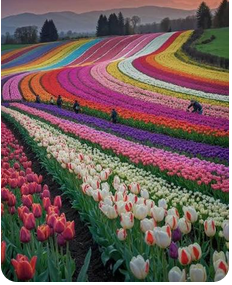
Nothing announces the arrival of spring quite like the vibrant, unmistakable silhouette of a blooming tulip. Whether scattered across a meticulously planned garden bed or arranged neatly in a vase on the kitchen counter, tulips bring an effortless elegance to any space. But beyond their colorful petals lies a fascinating botanical history of ancient mountains, royal palaces, and economic frenzy.
Here is everything you need to know about one of the world’s most beloved flowers—from its wild origins to tips for growing a stunning display in your own soil.
A Journey Through Botanical History
While we heavily associate tulips with the windmills and vast fields of the Netherlands, these resilient flowers actually originated in the rugged Tian Shan mountains of Central Asia. By the 10th century, tulips were widely cultivated by the Turks and became prized possessions within the Ottoman Empire. In fact, the word “tulip” is derived from the Persian worddelband, meaning “turban,” a nod to the flower’s distinct shape.
The tulip made its way to Western Europe in the late 16th century, largely credited to Carolus Clusius, a biologist who planted some of the first bulbs at the University of Leiden in the Netherlands in 1593. This introduction sparked a cultural and economic obsession.
During the 1630s, the Netherlands was gripped by “Tulip Mania”. The flowers were considered a sign of ultimate status, and their bulbs became so extraordinarily valuable that they triggered what historians consider the first recorded economic bubble. At the height of the craze, a single rare tulip bulb could be sold for the equivalent of a grand Amsterdam estate.
The Mystery of the “Broken” Tulip
During Tulip Mania, the most sought-after blooms were those with dramatic, flame-like stripes of contrasting colors. The most famous of these was theSemper Augustus, which featured striking crimson stripes against white petals. For centuries, no one understood what caused these intricate patterns.
It wasn’t until the 1920s that researchers discovered the cause: a mosaic virus known as the “Tulip Breaking Virus”. While the virus created stunning visual variations, it progressively weakened the bulbs until they could no longer produce flowers. Today, those diseased varieties are no longer sold; modern botanists have hybridized genetically stable tulips that replicate those breathtaking “broken” patterns without compromising the health of the plant.
Understanding Tulip Varieties
Today, there are over 100 wild “species” tulips and more than 3,000 cultivated variations. When planning your spring garden, you generally have two categories to choose from:
Species Tulips: These are the resilient, unmodified wildflowers. They are generally smaller, closer to the ground, and have pointed petals, making them excellent for rock gardens or naturalized areas.
Variations (Hybrids): Bred for size and dramatic color, these are the classic garden tulips. They come in nearly every color of the rainbow—except true blue—and feature varied shapes ranging from the classic cup to ruffled “Parrot” tulips and double-blooms that look strikingly similar to peonies.
Planting and Soil Secrets for Your Spring Garden
To achieve a spectacular spring display, planting must happen in the autumn. Tulips require a period of cold dormancy to trigger their spring bloom.
Soil Management: Tulips despise “wet feet.” They require well-draining soil to prevent the bulbs from rotting over the winter. If your garden has heavy clay, consider amending it with compost or sand, or opt for raised beds to ensure proper drainage.
Planting Depth: A good rule of thumb is to plant the bulb about three times as deep as the bulb is tall—usually around 6 to 8 inches deep. Plant them pointy-side up!
Critter Control: Squirrels, chipmunks, and deer view tulip bulbs as a delicious snack. To protect your investment, consider placing chicken wire just under the soil surface after planting, or interplant your tulips with daffodils, which are toxic and generally avoided by pests.
3 Fascinating Facts About Tulips
They Keep Growing: If you cut tulips for a vase, they don’t stop growing! Stems can elongate by an inch or more in the water as they search for nutrients.
They React to the Weather: Tulips are thermonastic, meaning their petals open wide on warm, sunny days and close tightly when temperatures drop to protect their pollen.
They Are Edible: If grown organically without chemical pesticides, tulip petals are perfectly safe to eat. They have a mild, sweet crunch and were even consumed by many—including Audrey Hepburn—during the Dutch “Hunger Winter” of World War II to stave off starvation. Today, they are occasionally used as an elegant garnish for salads and desserts.
Whether you are drawn to their rich history, their wide array of colors, or the simple joy they bring after a long winter, tulips are an incredibly rewarding addition to any landscape.