

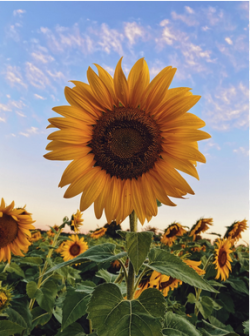
The history of the sunflower (Helianthus annuus) is a fascinating journey from a wild North American native to one of the world’s most important oilseed crops. Its story spans thousands of years, multiple continents, and diverse cultural uses.
Sunflowers originated in the Americas, with wild varieties spreading across much of North America, particularly the central and southwestern regions. Archaeological evidence shows that Indigenous peoples began cultivating and domesticating the plant as early as around 3000 BC, with some sites suggesting even earlier use dating back over 4,000–5,000 years. Native American tribes in areas like present-day Arizona, New Mexico, and the eastern woodlands transformed the bushy, multi-headed wild plant into a single-stemmed variety with larger seeds in colors like black, white, red, and striped. They selected for bigger seeds through generations, increasing seed size dramatically.
For these communities, sunflowers served many purposes beyond food. Seeds were eaten raw, roasted, ground into flour, or pressed for oil used in cooking, as sunscreen, hair conditioner, or body paint. The plant had medicinal applications, such as treating inflammation or chest pains, and ceremonial roles—some tribes linked tall, blooming sunflowers to abundant harvests or fat buffalo for good hunting. In some cultures, they symbolized provision, harvest, and spiritual connections to the sun.
European contact changed the sunflower’s trajectory. Spanish explorers first encountered the plant in the early 1500s (around 1510) and brought seeds back to Europe, where it initially gained popularity as an exotic ornamental garden flower. For about two centuries, Europeans largely overlooked its food and oil potential, using it more for decoration or minor medicinal purposes like anti-inflammatory treatments.
The plant’s commercial rise began in the 18th century, particularly in Russia. Introduced there (possibly via Peter the Great’s travels), sunflowers thrived in the climate. The Russian Orthodox Church played a key role by restricting many oils during Lent—sunflower oil, being plant-based, became a permitted alternative. By the late 1700s and early 1800s, cultivation exploded, with millions of acres grown. Russian breeders focused on oil content, developing high-yielding varieties. In the 19th century, “Mammoth Russian” or “Russian Giant” seeds were exported back to the United States, sparking renewed interest.
In the 20th century, sunflower breeding advanced significantly. Soviet scientist Vasilii Stepanovich Pustovoit pioneered selections for higher oil yields in the early 1900s. Breakthroughs in hybrid production—including cytoplasmic male sterility in the late 1960s and fertility restoration in the 1970s—enabled modern high-performance hybrids. Today, sunflowers rank among the top global oil crops, with major production in Ukraine, Russia, the European Union, Argentina, and the United States. Ukraine has embraced the sunflower as a national symbol of peace, vitality, and resilience.
Across cultures, sunflowers carry rich symbolism. In Western traditions, they represent adoration, loyalty, and happiness—evoking the myth of Clytie, who turned into a sunflower gazing at the sun god Apollo. In Chinese culture, they signify longevity, good fortune, and yang energy. Native American views often tied them to abundance and provision.
From ancient domestication in the Americas to global staple, the sunflower’s history reflects human ingenuity, adaptation, and enduring appeal—its bright face still turning toward the sun as a symbol of optimism and warmth.